
Join us for service at:
Meadowbrook Country Club
2149 N. Green Bay Road
Racine, WI 53405
Sunday Summer Services 10 a.m.



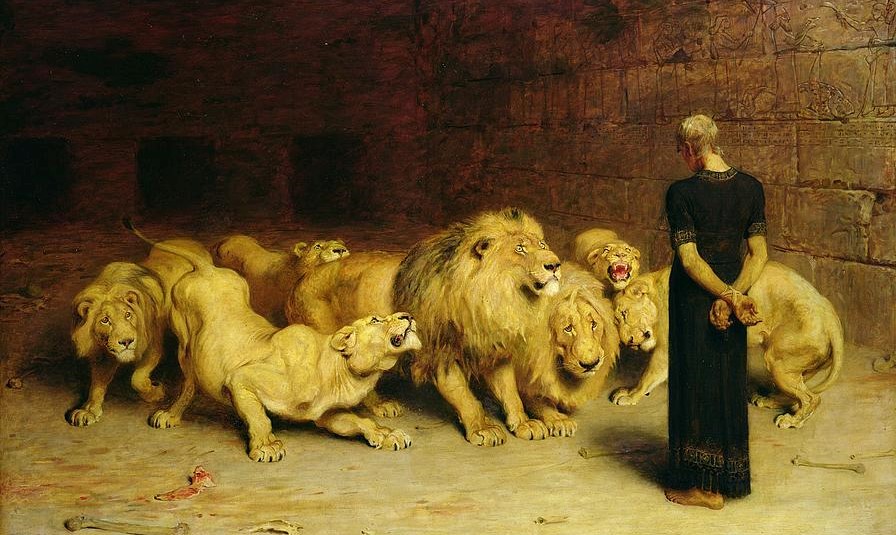
Daniel & the Lions' Den
The Old Testament has four so-called “major prophets” – Isaiah, Jeremiah, Ezekiel and Daniel. Daniel is the most recent of all the Old Testament books to be written, probably in the first part of the second century during the time of Antiochus Epiphanes, but it pretends to be written 400 years earlier during the time of the Babylonian exile in the 6th century BCE.
Fun facts: we can credit the book of Daniel with many familiar literary phrases: “the handwriting on the wall,” “Ancient of Days,” “feet of clay,” and “entering the lion’s den.”
As you read the book of Daniel, it is exceedingly clear that it is divided into two parts. Chapters 1-6 is a collection of myths and folk tales probably originating during the Persian era from 529 – 333 BCE. They reflect Persian court customs and interests but are written from a Jewish point of view using our hero Daniel and his friends who were taken captive in the Babylonian exile as young boys and brought up in the court of the Babylonian king.
The second half of the book, is strongly apocalyptic (uncovering or revealing the future) and reads somewhat like the book of Revelation. Chapters 7-12 are comprised of four visions, which Daniel interprets, and through which Daniel is shown the events of the centuries to come right down to the time of Antiochus Epiphanes and his persecution of the Jews in the second century. This kind of writing is called a “prediction after the fact” in which an author creates a character of long ago and puts into his mouth as prophecies, or predictions, all the important events that have already happened up to the author’s own time and place. The hope is to give meaning to current events by showing that God has been with the people all along permitting everything that has happened and planning to once again rescue the Jews soon.
The book of Daniel essentially used Jewish heroes from ages past to strengthen Jewish resistance to the Seleucid king Antiochus Epiphanes during the period of the Maccabean revolution in the 160s BCE. King Antiochus was trying to Hellenize the area, bringing in Greek practices, Greek games, rituals, language, coins, gods and goddesses. Some Jews didn’t mind the modernization (if you will) and became Hellenized Jews, but others wanted nothing to do with this change. This created a huge conflict between the Seleucids and the non-Hellenized Jews. During this time, according to John Shelby Spong in his book Re-Claiming the Bible For a Non-Religious World, “Religious persecution against the Jews had reached horrendous proportions. The Jews were forced by their enemies to eat food they regarded as unclean. The Temple itself was polluted with the installation of the head of a swine in the Holy of Holies, an unclean animal in the very dwelling place of God... Those Jews who refused to violate their religious practices were summarily executed.”
So many were executed in horrible, torturous ways (if you like horror stories, try reading the Apocryphal book of II Maccabees, chapter 7) that the situation gave birth to a new concept within Judaism – life after death. And even more specifically, heaven and hell. Until this point, the Hebrew scriptures occasionally spoke of a place called Sheol, a place of death, where all people went when they died, but it was not a place of punishment or comfort.
But now, with no earthly reward for the martyrs, what was the point? As Spong states, “if faithfulness to God was not to be rewarded beyond this life, then God could not be just. If that is so, then evil does in fact triumph over God. So, heaven and hell became the categories of divine justice and the afterlife was employed to make fair this unfair world. The book of Daniel was pivotal in this transformation.”
There are two very well-known miracle stories in the book of Daniel all revolving around four young Jewish men – Daniel, Hananiah, Mishael, and Azariah - who were strong in their faith, kept the Jewish laws, prayed constantly and refused to be assimilated into Persian ways.
Chapter three tells the story of Hananiah, Mishael, and Azariah, who are renamed by King Nebuchadnezzar: Shadrack, Meshack and Abednego. All three refused to worship a 90-foot-tall golden statue that Nebuchadnezzar had built. Their punishment was to be thrown into a fiery furnace. The furnace was so hot that those who were carrying the three men into it all perished. But Yahweh protected them and Shadrack, Meshack and Abednego emerged unscathed.
And then, of course, we have the story of Daniel who, years later, refused to pray or pay homage to King Darius, and so was thrown into the lions’ den. He also emerged unscathed.
Certainly, if we’d lived 2200 years ago and were being persecuted for our religion, these stories might give us the strength to stay true to our traditions and beliefs. Shadrack, Meshack and Abednego were even willing to concede that God might not save them from the fiery furnace, but they still weren’t going to worship some crazy golden statue.
Today we’re under no illusions that these were stories. If someone literally threw us in a fiery furnace or to the lions, we would be dead. So, let’s look at these stories metaphorically. Metaphorically, what does it mean to walk through the fiery furnace or the lions’ den? Getting through really difficult times – death, divorce, job loss, rejection; maintaining our integrity and honesty; standing for justice; refusing to do something illegal, immoral, going through a health crisis, bullying, or being the butt of gossip and lies. I don’t doubt that each person has a story about their own fiery furnace or lions’ den experience.
These stories call all of us to examine our loyalties and our integrity. Perhaps more importantly, they remind us that no matter what hard thing we are going through, the Divine Presence is with us to sustain and care for us, even if we feel alone. In personal, communal, or societal situations, there is a undercurrent to life that we can draw upon to give us the courage and strength to stay true to ourselves and to stand for the power of Love that calls us to peace, compassion and justice.
Love & Light!
Kaye