
Join us for service at:
Meadowbrook Country Club
2149 N. Green Bay Road
Racine, WI 53405
Sunday Summer Services 10 a.m.



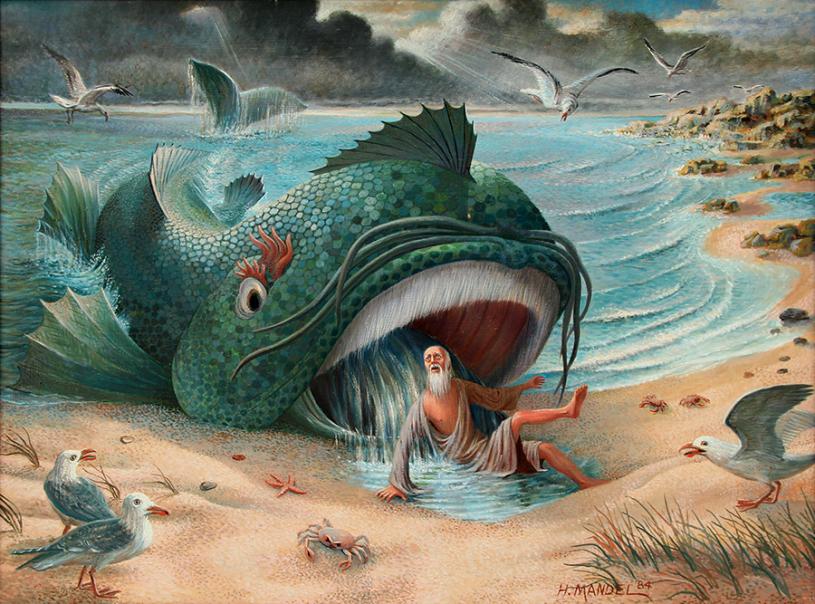
Jonah: No Boundaries on Love
Jonah is a book unlike any other book in the Bible. It’s a story about a prophet who does everything a prophet of God should NOT do. It is full of humor and irony and was clearly written to entertain its audience.
This small book of only 48 verses has scholars boggled over simple questions like: Who wrote it? When? Where? Why? And under what circumstances? Frankly, in my research, it was easy to get overwhelmed by the differences in opinion and “supporting evidence” to back their perspectives. The most we do know is that it was written sometime between the 8th and 2nd centuries BCE, and that it is part satire, part folktale, part parable and part midrash. From there the book lends itself to multiple interpretations and purposes.
Which left me to choose the one that made the most sense to me and offered the most pertinent message for our times. Of all the scenarios I read, I found myself drawn to the explanation offered by former Episcopal Bishop John Shelby Spong, in his book Re-Claiming the Bible for a Non-Religious World.
He invites us to consider this context. The Israelites spent about 50 years in exile in Babylon until the Persians (under Cyrus the Great) conquered the area in 538 BCE and allowed the Israelites to return to their homeland, which they did in smaller and larger groups over the next 200 years.
The big concern of the Israelites would then have been how to keep from getting exiled again. If they did something to make God so mad that Yahweh had them carted off to another country for a while, perhaps they had better figure out what they did. Repeatedly in the Old Testament, the Israelites started worshipping local gods and inter-marrying with gentiles. Spong believes that this was once again identified as “the problem” to be solved. They pointed the finger at the Gentiles in their midst leading them astray and bringing corruption to the nation. The solution? Rid their nation of outsiders. Purge the non-Jewish elements by banishing them from the land. All half-breed children must also go. Spong writes, “The new land of the Jews must be for Jews only… The true worship of a racially pure Jewish people was the only way to secure God’s blessing.” As we can imagine, a time of internal chaos and violence ensued.
Spong suggests that it was this atmosphere that prompted a Jewish man to confront these elitist, purist, judgmental attitudes in a way that could be heard, with humor and drama and satire. The story of Jonah held up a mirror to those who would reduce God to their possession - a tribal deity. And Jonah challenges our utterly human response of judging those we don’t like as being unworthy in God’s eyes.
So, let’s take a look at the story.
The book of Jonah begins with Yahweh speaking to Jonah and telling him to get up, go to Ninevah and tell them to shape up.
It’s important to note that Nineveh was the capital city of the gentile Assyrian empire that ruled the entire area from roughly 900 to 600 BCE. You may remember that Israel’s first exile from their homeland was by the Assyrians in about 800 BCE. The Assyrians had a reputation for their barbaric cruelty. Archeological artwork portrays beheaded victims, impaled enemies and trampled corpses. During one period of their rule, if one of the kingdoms under the Assyrian empire dared to rebel, they didn’t just execute and replace the vassal king, the Assyrians would wipe out the entire population or deport them to far-off lands. Under this pressure, Israel lost three-fourths of its lands to Assyria.
Of course, by the time Jonah was written, Nineveh had already been destroyed. But the people listening to the story would have completely understood the reference to the vile, gentile city of the Ninevites.
Given all this, it’s not hard to understand why the fictional figure of Jonah wanted nothing to do with helping “those people.” Jonah couldn’t stand “those people.” So, Jonah booked passage on a ship in the opposite direction. But Yahweh whipped up a great storm that scared the sailors and threatened the ship. They threw all their cargo overboard first to help keep from sinking but it wasn’t enough.
So, the sailors cast lots to figure out whose fault it was. Turns out it was Jonah’s fault! When confronted, Jonah admitted that he was a Hebrew who was trying to escape from Yahweh. When asked what they should do to get Yahweh to calm the storm, Jonah told them to throw him overboard.
If Jonah thought he could surely escape Yahweh by drowning, he was very wrong. Yahweh simply had Jonah swallowed by a big fish (not a whale), carried around for three days and nights and then spewed out on land. Yahweh then spoke to Jonah again, Are you ready now? Go to Nineveh and do what I told you to do.
What choice did he have? Jonah went and spoke to the people of Nineveh (in what I imagine to be a passionless voice): Only forty days more and Nineveh is going to be destroyed. Immediately the people believed and they all put on sackcloth and ashes, even the animals! God approved and relented.
But Jonah was angry and complained. See, Yahweh, this is exactly why I didn’t want to come here. I knew they would say they would change and I knew you were a God of tenderness and compassion, slow to anger, rich in kindness, relenting from violence. Now, please take my life, I’d rather be dead than keep living.
Yahweh responded, “Seriously Jonah, what gives you the right to be angry?”
Jonah didn’t answer but left the city to go off by himself and pout. Then God sent a castor oil plant to grow up and shade Jonah from the heat and Jonah was delighted with the plant. The next day God caused the plant to wither up and die, and Jonah started back in on his whining: I’d rather be dead than living!
Yahweh asked Jonah, “What gave you the right to be upset about the plant?”
Jonah exclaimed, “I have every right to be angry, even to the point of death!”
Yahweh has the last word, “You feel sorrow for a plant you had for only a day. Is it not right that I should feel sorrow for the 120,000 people of Ninevah who can’t tell their right hand from their left, to say nothing of all the animals?”
The audience is left with that question…
Now, imagine being on the streets of Jerusalem, in the midst of a little ethnic cleansing, listening to this story. You’d be roaring with laughter at the stubbornness of Jonah, the futile running from Yahweh, the silliness of his attachment to a plant, and nodding your head when you heard God’s last line. But then perhaps it would sink in… Jonah was a fictional portrayal of you! If God could love those miserable, rotten, gentile Ninevites, that probably meant God also loved and cared about all of the half-breeds and gentiles that you were scouring from your midst. Darn it all. You were the chosen people, you were keeping all the laws, you were praying and giving offerings… not them. They didn’t deserve God’s love. Yahweh belonged to you, not them.
Oh, that sounds familiar, Jonah didn’t want God to be merciful or care about Nineveh because, in Jonah’s opinion, they didn’t deserve it. This reminds me of a line in an old Clint Eastwood movie where he says, “Deserve’s got nothing to do with it.”
When it comes to God’s love and care for all people – deserve’s got nothing to do with it. But, oh, we have a hard time with that. Personally, I think that’s the appeal of the fictional place of hell where we can send all the people we don’t think are worthy.
My favorite Anne LaMott line of all time is: We know we’ve created God in our image when God hates all the same people we do.
Why do we resist this notion so strongly – that God loves and cares for all people? Is tribalism part of our survival instinct? Is it our own insecurity about our value and our beliefs? Have we been programmed to fear the “other” by society? Do we feel stronger and safer when we vilify those we don’t agree with?
If you’re being honest with yourself, who are you prejudiced against? Who would you like to see banished to another country? Who would you really rather NOT help?
Pastor John Buchanan tells the story of a church secretary he’d worked with many years ago “whose real love, her abiding passion actually, was politics: national politics, but particularly local party politics—partisan, personal politics… Every morning when she got to work, Anne would regale [him] with political stories, horror stories, stories about how awful the other people were; how dishonest and unfair and uncaring; how occasionally crooked and evil. And every morning at the end of the “diatribe du jour”… she would conclude by saying, “God is going to get them for that!”
He claims she wasn’t serious, but it is such a human proclivity to divide the world into “us” and “them,” dig our heels in and convince ourselves we’re better. It can be energizing when we’re cheering for our home team over our archrival. But when it comes to race, ethnicity, sexuality, and religion, people are quickly demonized, marginalized, and rendered expendable and undeserving. Then the stakes become incredibly high, sometimes even life and death.
I’m certain we can think of a multitude of ways our society and/or church is blatantly or subtly determining who deserves (or doesn’t deserve) life, liberty and the pursuit of happiness? Consider just a few:
- Profiling People of color
- Cleansing the immigrants
- White Christian Nationalists
- Discriminating against LGBT, especially trans people
- Birthright citizenship
- School funding
- Health care coverage
- Lack of a living wage
- Lack of affordable housing
- Voting rights, access, etc.
- Cities who throw people in jail for being homeless
It seems to me that believing in a Sacred Presence that is in and through all things must acknowledge that the Divine doesn’t belong to any single person, country or religion. God must be bigger than my ability to understand and explain. God must transcend our limits, our barriers and our borders. God’s love must be bigger than my prejudices.
In Jonah we have a Jewish story about God’s mercy toward “them”—the hated foreigners, the racially impure, religiously incorrect, decidedly unchosen. I find it amazing that, at the heart of the Old Testament - which we think of as painting God as violent, punishing, vengeful - is a small, amusing (often overlooked) story with a radical message: God loves everyone. Even the Ninevites. Even “them” – whoever “them” is for each of us.
This is the message of Jonah that gets lost in a big fish story. Perhaps it is time to reclaim it and live it.
Love & Light!
Kaye