
Join us for service at:
Meadowbrook Country Club
2149 N. Green Bay Road
Racine, WI 53405
Sunday Summer Services 10 a.m.



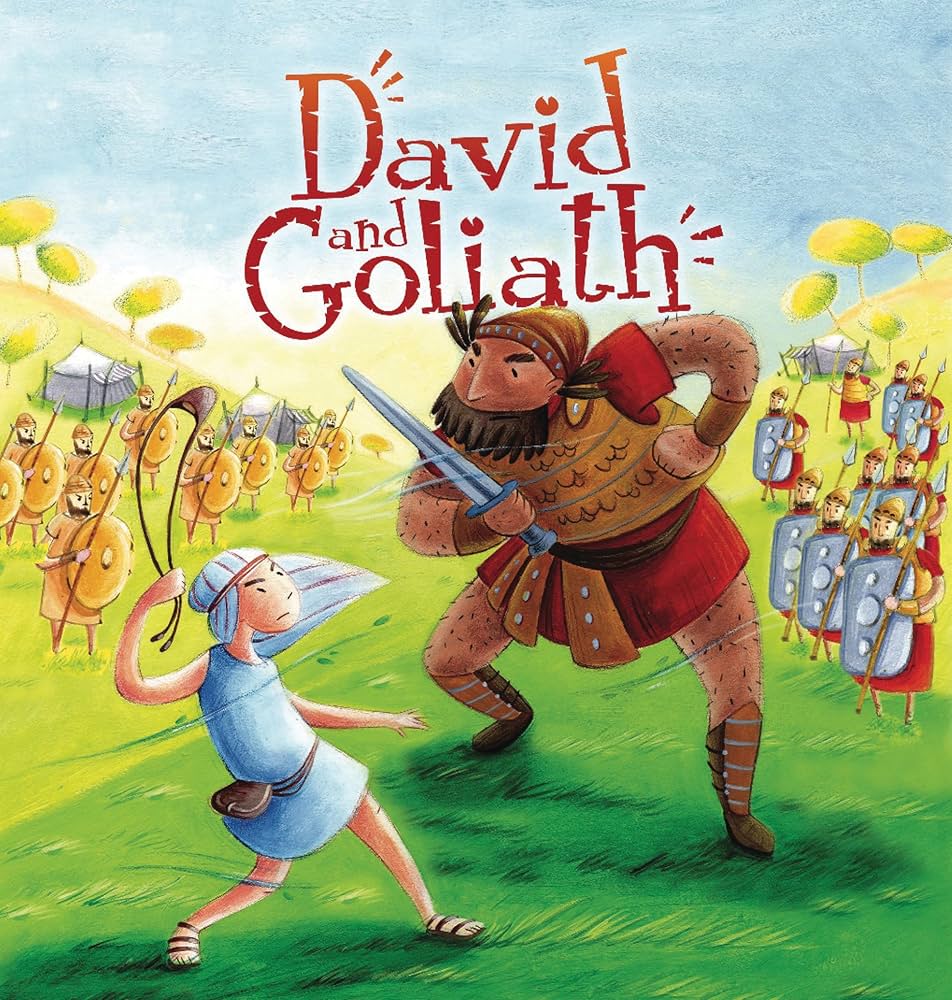
David & Goliath: Standing with the Living God
One of the things I have appreciated most about this summer series is the opportunity to refresh my memory on the history and evolution of the Jewish people and religion. This is like a sweeping saga where we flow through the generations, the loves, the battles, the treachery, the faithfulness, the deceit and lies, heroes, heroines, enemies and villains. We’ve traversed the centuries through the eyes of the ancient Israelites, heard their understanding of their god Yahweh from the creation of the earth and humanity, to the formation of a covenant between the people and Yahweh, to the beginning of the tribe of Israel, to the time of the judges. Now we find ourselves in the book of 1 Samuel which transitions us to the era of the kings.
First Samuel is another Old Testament book woven together from multiple sources, so there are contradictions and differences of opinion. For example, one tradition was in favor of the tribes becoming a monarchy, another was not. In the end, those in favor won the day and Yahweh agreed to anoint a king. The era of kings brought a time of centralized power and wealth, the development of urban centers, an economic monopoly and an oppressive social order. They saw the growth of tradition and technology, and there was an emphasis on theological and divine legitimacy.
The conclusion of the book of Judges states: “In those days there was no king in Israel and the people did as they pleased.” The tribes of Israel were facing internal corruption, political chaos and moral decline and the Philistine’s still posed a huge threat. There is little reason to believe they could’ve pulled themselves out of this downward spiral without significant change.
The book of Samuel opens with the plight of Hannah, the wife of Elkanah, who was barren and constantly taunted by Elkanah’s other wife because of it. Hannah prayed a desperate prayer to Yahweh, that if Yahweh would give her a boy, she would dedicate him to the temple, and no razor would ever touch his head. Yahweh granted her request, she gave birth to a boy, named him Samuel, and dedicated him to serve at the temple of Shiloh under the priest, Eli. When Samuel was older, he received a special call from Yahweh and became both a priest and seer.
After a particularly terrible defeat by the Philistines in which Eli and his sons were killed and the ark of the covenant was stolen, Samuel emerged as the one religious force in the country.
The threat from the Philistines was so strong that the twelve tribes of Israel realized they didn’t have a chance unless they united under one military leader. So, they begged Samuel to give them a king.
Eventually Samuel anointed Saul as their first king. While Saul was a great warrior, he was also moody, arrogant and had a rash temper. Because of this, scripture says that Yahweh regretted making Saul the king.
Enter young David, a shepherd boy, and the youngest son of Jesse of Bethlehem, an Israelite faithful to Saul’s throne.
Because of the multiple sources making up the book of 1 Samuel, the audience is introduced to David three times, in three completely separate stories. The first is Yahweh sending Samuel to secretly anoint David to be the next king (despite the fact that King Saul was still alive.) The second comes from another tradition wherein Saul is tormented by an evil spirit. His attendant suggested David come and play his harp for him to soothe his frazzled nerves.
Our third introduction to David is the most well-known. It is the epic legend of David and Goliath which, over the centuries, has captured the imagination of people everywhere and has become a cultural cliché for hoping the underdog will triumph over the giant. It has been painted by such greats as Caravaggio, sculpted by Michaelangelo and Bernini, had music composed by Handel, and has more literary, political, movie, sports and song references than we can count.
And yet, a close read of the story shows us that it is not simply a story about rooting for the underdog. David is not just a little guy with good aim. Whereas King Saul and the armies of Israel can’t fathom winning a military fight against Goliath and the much stronger, more well-equipped Philistines, David doesn’t even see it as a contest of strength. David sees it as a matter of faithfulness and trust.
Because King Saul and the armies of Israel could think only in terms of a force of arms, it left them paralyzed by fear. But David saw clearly what they did not. David saw the Philistines as being foolish enough to take the offensive against Yahweh, the living God of Israel. David would not be bullied by the arrogant Goliath because in his heart he knew that to stand with Yahweh was to stand with a powerful force for life. David was even a little bit offended on the part of Yahweh that King Saul and the Israelites did not trust Yahweh to be with them in battle. So, he takes up the challenge himself, with courage and trust.
Our world seems to be full of Goliaths at the moment: war, inflation, bullying, ICE, inequity, billionaires, politicians, pollution, climate change, lack of affordable housing, violence, our broken health care system, religious fundamentalists of every persuasion and more.
An article on NPR on July 28, talked about teen artists this summer who explored the question: "What is it like to be a teen right now?" and were asked to create “honest portrayals of their lives and the issues they face.”
Their work was exhibited in two separate showings of their work – one at the American University Museum in Washington, D.C., and another at the Smithsonian Folklife Festival.
Let me describe three of the submissions because they speak to me of giants. One was a painting by teen artist Betty Shanefelter entitled “Falling.” The painting is of a teen-age girl in a free-fall, back to the ground, arms reaching out desperately, legs flailing, and a look in her eyes that is desperate, fearful and hopeless. How many youth – and others – feel like they are in a free fall? Feeling like they’ve lost the ground under their feet? Perhaps it speaks to the continuing rise of depression and anxiety faced by all generations.
The second, created by three students (Alexander Weiss, Mia Melton and Lois Proeller), was a life-size classroom installation with loudspeaker blaring an announcement on loop: "Lockdown, lockdown. This is an emergency alert." One of the artists said the goal was to make viewers understand the "looming fear" of school shootings that students live with every day.
In the third example, a group of young artists with the Museum of Contemporary American Teenagers (MoCAT) made a mural about their lives, "from the stresses of college acceptance to protests to dealing with the coronavirus pandemic to self-image," said artist Flair Doherty. In the mural, protesters are holding signs that read "The climate is changing, why aren't we?" "No human is illegal," "Protect kids, not guns" and "Free Palestine." The Smithsonian covered the mural with tarps the following day, saying the Smithsonian didn’t allow promotion of individual political agendas. As a side note, “Free Palestine” was painted by a Jewish student.
These youth have pointed out dramatically, metaphorically, and poetically, the Goliaths that are bullying our children, our young people, and yes, us. What type of society are we handing down to the next generation? What values? What priorities?
Who will we be in response to these Goliaths – David or the Israelites?
Where is God in the midst of this? Is it naïve to believe there is a spiritual force, energy, presence for us to draw on for courage and strength.
The story of David has empowered people of all ages to believe and trust that yes, there is Something More – a living God - working within, through and among us for good, for justice, for light. It may not help us take down the giants as easily as David took down Goliath, but people who have fought for justice throughout the ages have consistently turned to Yahweh, an unbounded energy of Love (however you want to understand the spiritual presence), for strength, wisdom, tenacity, resilience and courage. For us it will not only take trust in this Presence, but truthful speech, courageous confrontation, and faithful action.
Love & Light!
Kaye