
Join us for service at:
Meadowbrook Country Club
2149 N. Green Bay Road
Racine, WI 53405
Sunday Summer Services 10 a.m.



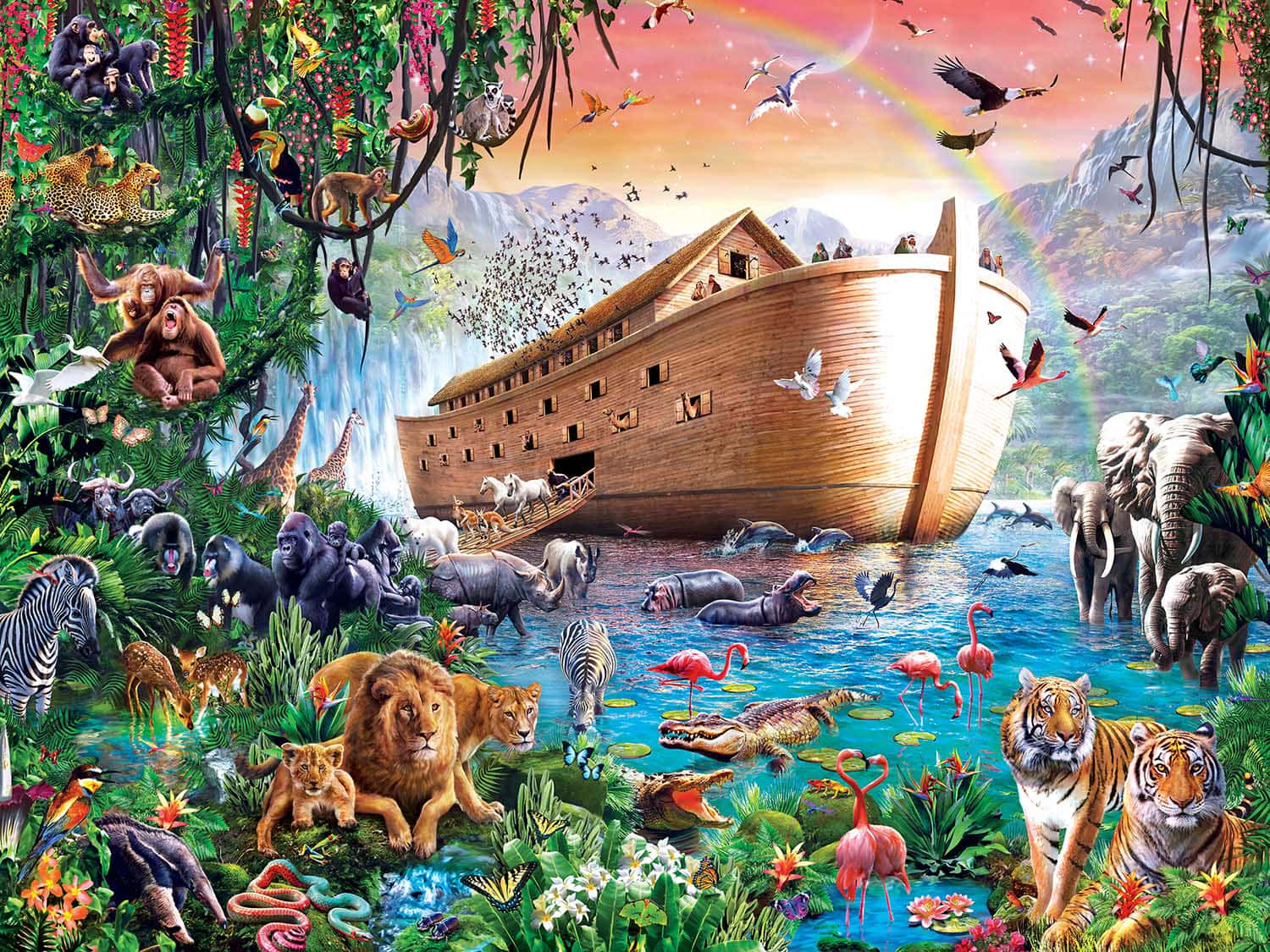
God's Conundrum
In our discussions about Old Testament stories this summer take notice of how so many of them are connected genealogically. As we examine the story of Noah's ark this week, we recognize that Noah was a distant descendant of Seth, Adam and Eve’s third son (Genesis 5).
Just like the creation stories were written by two authors, the story of Noah’s Ark has two authors. But in this case, they aren’t conveniently separated like the first creation story and Adam and Eve. In the case of Noah, the two accounts were likely passed along by oral traditions for hundreds of years before they were woven together (which may account for some of the repetition). The story as we have it was most likely compiled into its current form around 500-600 BCE, during or right after the Babylonian exile (597 – 538 BCE).
As I said last week, the ancient people were tribal people and each tribe had their own god or goddess (or multiple). Nearly every continent and culture has a flood story which attempts to explain why the land was flooded so badly. Noah’s Ark sounds strikingly similar to the Mesopotamian Gilgamesh Epic (written around 1300 – 1000 BCE) - one of the oldest written stories in human history. It features Utnapishtim, who is warned by the god Ea to build a massive boat to save his family, craftsmen, and animals from a devastating flood.
If you’re curious, search the internet for ancient flood stories!
Geologically we know that there was a major flood in the Mesopotamian valley dated around 3000 BCE. But there is no evidence of that kind of a flood in the land of Canaan, nor of a worldwide flood. And, no, the ark was not found, no matter what anyone says. Noah’s ark was a story.
Please remember, these Old Testament stories are not only not to be taken literally, but that these are memory stories for the tribe of Israel to help them share their understanding about God within the context of their history and experience. These are not stories of what God said or did, they are stories of what Israel said God said and did.
True confessions, I used to read Noah’s Ark to my kids. And then the more I thought about it, the more I realized it was an awful story. In twenty-nine years of ministry, I’ve never preached on it because what good is there? God got so disgusted with God’s OWN CREATION, that God destroys nearly all of it?
As we study the Old Testament, Walter Brueggemann encourages us to nurture a historical imagination to be open to the “pulses of meaning that can be discerned in reflection upon historical experience preserved in a historical community.” In an age of science and technology where we want facts and answers, it seems almost counterintuitive to use our imagination. We want what is provable and measurable. But spirituality just doesn’t work that way. And the ancient tribe of Israel didn’t work that way. To try and force facts about a flood, or about God, out of the story of Noah’s Ark is completely missing the point.
So, what was the point? That’s what our imagination gets to play with – the possibilities of meaning to the ancient people.
The first creation story, Adam and Eve, and other OT stories are more than simply myths. They paint a picture of a relationship between God and God’s people. The God of the Hebrews is not a remote God, but a personally invested God, a God who loves God’s creation.
In the Garden of Eden, God created a space where there would be harmony, equanimity, equality, love, respect, caring. It was a space of unity where all things would be interconnected in a beautiful, intricate web. But almost from the very beginning, God’s dream for creation is challenged by the human creatures disobeying. So, they are kicked out of the garden but not deserted. God is still with them, hoping that they will make good, sound choices that will match God’s dream for them and the earth. (Sounds a lot like how we feel when we send our kids off to college.)
However, people continued to make bad decisions. Cain killed his brother Abel out of jealousy. And subsequent generations were also violent, corrupt, and murderous. There was a fracture between God and God’s creation that just continued to grow. God had a plan, an expectation, a purpose, a beautiful dream for God’s creation. But it just wasn’t turning out as planned. Humanity missed the whole purpose of a beautiful, harmonious, peaceful world to live in. Humans treated each other and creation shabbily, and so God by extension.
What is interesting is that we’re not really dealing with an angry God – I brought you into this world and I can take you out! It’s so much more, God is grieved, God’s heart is pained. Something is deeply wrong and God’s dream will not be fulfilled. The world is creating its own future, and it isn’t anything like the future God envisioned.
So, we come to God’s conundrum… I created this and it isn’t what I thought it would be! In fact, it is awful… now what do I do??
Brueggemann suggests that the story of the flood is not so much about the crisis of the world, but the crisis of the heart and being of God. Yes, God chooses to send a flood to destroy everything, but a close reading gives one the sense that God really doesn’t want to (this is going to hurt me more than it hurts you!) God doesn’t know how else to fix it and regrets creating all of it in the first place.
In the midst of this depressing story of pain is one bright, shining light. One hope: Noah. Noah is the antithesis of Adam and Eve, and Cain, and others who have wrought havoc on God’s order and run roughshod over humanity’s covenant with God. Noah listens and trusts implicitly. Noah is the first truly faithful human being and God’s hope for a new creation.
Now, I’m not sure how you feel about whether God can change or not. I’m not even sure how I feel about it. But somewhere between the beginning and the ending of this story, God changes. God realizes that the flood really didn’t change anything; humanity is never going to be perfect. God’s dream will never be realized, and yet God resolves to stick it out with humanity. God will stay around, endure and help sustain the world God created.
So, God promises to never again wipe out everything with a flood. And to remind Godself (not humans) of this promise, God puts a rainbow in the sky and tells Noah that every time a rainbow appears it will remind God of God’s promise.
It was important for the ancient Hebrews to know that no matter how badly they screwed up, their God would not desert them. They were loved despite their mistakes. The relationship wasn’t about punishment and retribution, but unqualified grace and unconditional love. God still held a deep hope for humanity and charged Noah and his family to go forth and multiply, to be responsible for the wildlife, and to be accountable for their actions, especially not to go around murdering people! God was and is a God of second, third, fourth, and infinite chances.
If there is a takeaway from this story, I think this is it. There is a loving, sustaining presence that is intimately connected to each of us. Yes, we are still called to strive toward that dream of peace, harmony and equanimity. But in our freedom to do as we wish we will screw up, we will make bad choices and diminish God’s dream. But even if we do, we are still loved unconditionally and there is still hope.
Love & Light!
Kaye