
Join us for service at:
Meadowbrook Country Club
2149 N. Green Bay Road
Racine, WI 53405
Sunday Summer Services 10 a.m.



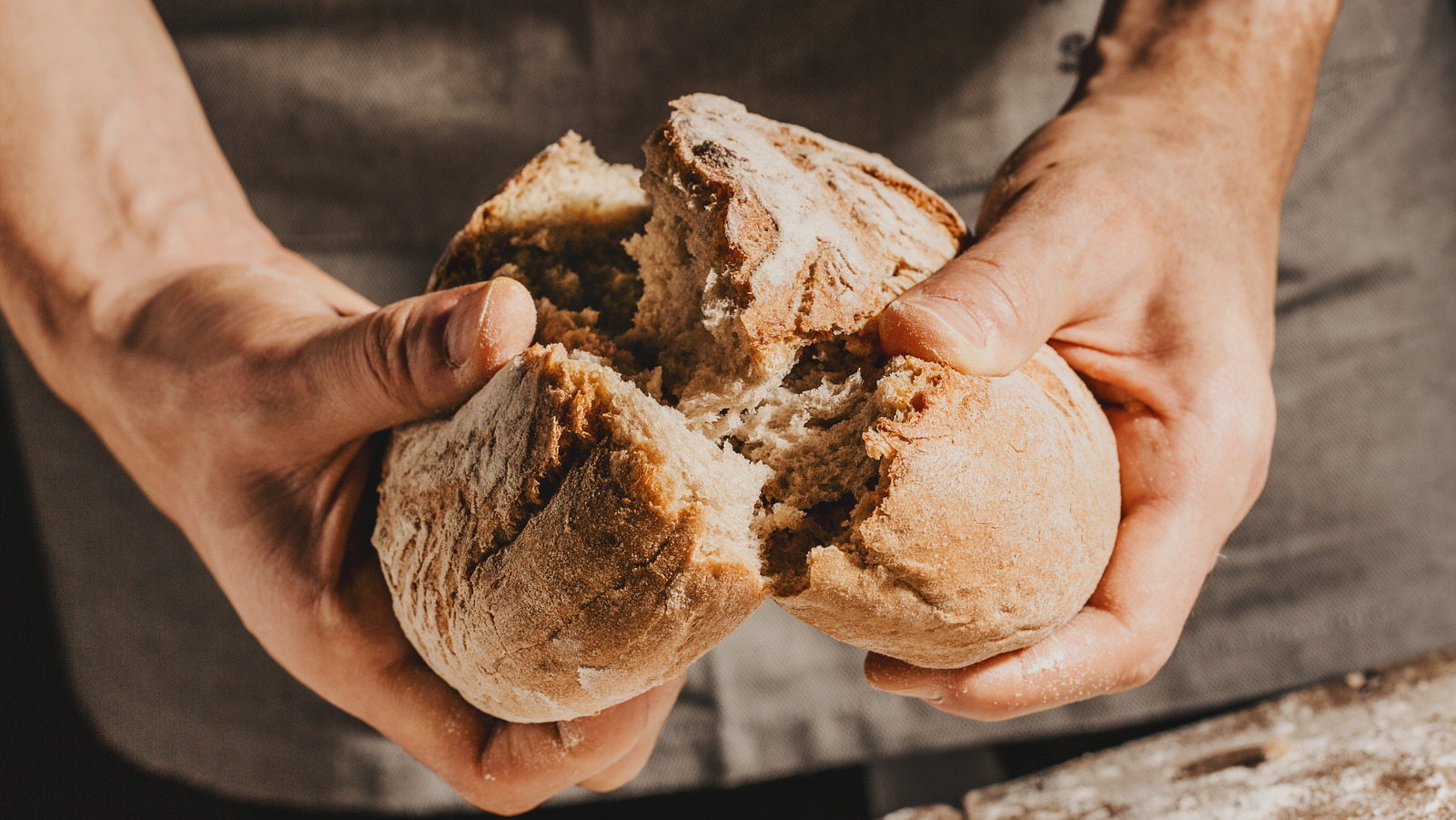
Revealed in Breaking Bread
The story of the Road to Emmaus is one of the most familiar resurrection appearances of Jesus. In it, Jesus speaks at length with Cleopas and his companion, but they don’t recognize him until he breaks bread with them. It reminds me of how many different times we hear that Jesus shared food with others. Consider the feeing of the 5,000, the Passover feast, the wedding at Cana, the story of Mary and Martha, eating with tax collectors, the meal Jesus made on a campfire at the Sea of Galilee after his resurrection, and more!
Now, consider times when you’ve shared food with others, maybe even broken a sandwich or loaf of bread, split a meal, or cut an apple. While these times may not reveal anyone’s identity, and not every meal is enjoyable, when we share in a manner of authentic caring, we feel love, worth, acceptance, community, connection, grace, belonging, and care.
Every time the disciples were with Jesus, and he shared food with them, I feel like they must have subconsciously experienced all these things sacred, wonderful feelings. Every time. So, I believe more than Jesus’ identity was revealed in the meal he shared with Cleopas and his companion. Divine Presence was revealed in this action of breaking and sharing. And still is in our own lives.
For many years I served churches who had camping trips in the summer. I always held a brief worship service on those trips, and we always broke bread - celebrated communion - together. One year when the service had ended and people had started to move their chairs to the campfire and potluck area, my son Sam, who was 7 years old at the time, ran up to me, arms outstretched. He had been waiting for this moment… truly he had been eyeing the communion bread for two days and I had promised him that after communion he could help finish off the bread that was left. As promised, I tore off a chunk of the loaf and he ran off happily. More of the kids were around and so I handed each of them a chunk, then shared with any adults who wanted more. The bread that had been so sparingly handed out just a few minutes earlier was now being shared abundantly. I came to the end of the loaf and turned around to see my daughter, Bryn (who was about 4 at the time) and a friend of hers with the other half of the loaf, excitedly tearing off pieces and dipping them one after the other into the juice. And all I could do was smile and think, “they are young and know the good stuff.” Without consciously understanding, they know they have a place at the table, that they belong and are loved. Even more than in the formal celebrating of communion, the Divine was revealed in the abundant sharing afterwards.
Gratefully, I have always been a part of a church that has had open communion, with no age requirements, or hoops or regulations to jump through. Everyone was always welcome at the table, as I believe it should be and as I believe Jesus would want it to be. If this is a special moment of revelation and inclusion, why would it ever be denied to anyone?
I am always saddened by the stories of those who have been turned away from communion. A woman I knew once grew up in the south in a Presbyterian church. When they moved to different town without a Presbyterian church, they began attending the Baptist church. She had always taken communion in the other church, so when communion was passed down the pews in the Baptist church, she and her sister reached to take a piece and the woman who was sitting next to her slapped her hand and told her she couldn’t have any because she didn’t belong to that church. As far as I can tell, Jesus certainly wasn’t revealed in that communion meal, nor were any of the other qualities like love and acceptance.
The spiritual revelation of love doesn’t require a church service or fancy words. Last summer we took a River cruise from Madrid to Porto, Portugal. On our third day there we visited Salamanca, a renaissance city in Spain dating back to 200 BCE. There was a beautiful ancient square in the city with some mouth-watering bakeries. One of them had huge croissants in the window… HUGE… like three times the size of a normal croissant! We had recently met a gentleman named Alan, who decided that we absolutely had to have the pistachio frosted one. Spontaneously he purchased one, and five of us sat down at a table together, passed it around and literally broke bread together. Three of us knew each other, but Alan and another woman were on the cruise by themselves. For me, this sharing contained all the same elements we spoke of. It expressed that we belonged and cared for each other even if we hardly knew each other. It expressed generosity, joy, and fun. The Spirit of Love was revealed in our sharing, and new friendships grew.
Sara Miles, in her book, Take This Bread, shares that she was raised by atheists, scorned organized religion, was a lesbian (which is only important in the recognition that so many churches were – and are - unaccepting of that) and had a career as a journalist covering revolutions around the world.
At the age of 46, Sara wandered into an Episcopal Church near where she was living in San Francisco, ate a piece of bread, took a sip of wine and found God revealed in the meal, much to her shock. What she found wasn’t about angels, or going to church on Sunday, or doctrine. In her words, “I discovered a religion rooted in the most ordinary yet subversive practice: a dinner table where everyone is welcome, where the despised and outcasts are honored.”
Soon she was not only receiving communion but helping to serve it. Then she felt compelled to take it one step further and she started a food pantry, giving away tons of food around the same Lord’s Table where she’d first received communion. Over time, she organized new pantries all over the city to provide hundreds of families with free groceries each week.
She wrote:
Holy communion knocked me upside down and forced me to deal with the impossible reality of God. Then, as conversion continued, relentlessly challenging my assumptions about religion and politics and meaning, God forced me to deal with all kinds of other people. In large ways and small, I wrestled with Christianity: its grand promises and its petty demands, its temptations and hypocrisies and promises, its ugly history and often insufferable adherents. Faith for me didn’t provide a set of easy answers or certainties: It raised more questions than I was ever comfortable with. The bits of my past – family, work, war, love – came apart as I stumbled into church, then reassembled, through the works communion inspired me to do, into a new life centered on feeding strangers: food and bodies, transformed. I wound up not in what church people like to call “a community of believers” – which tends to be code for “a like-minded club” – but in something huger and wilder than I had ever expected: the suffering, fractious, and unboundaried body of Christ.
As we share communion together, and as we break bread and share meals with family and friends, may we know the sacred beauty of these encounters, sense the spirit moving among us, and may we be reminded of something “huger and wilder.”
Love & Light!
Kaye