
Join us for service at:
Meadowbrook Country Club
2149 N. Green Bay Road
Racine, WI 53405
Sunday Summer Services 10 a.m.



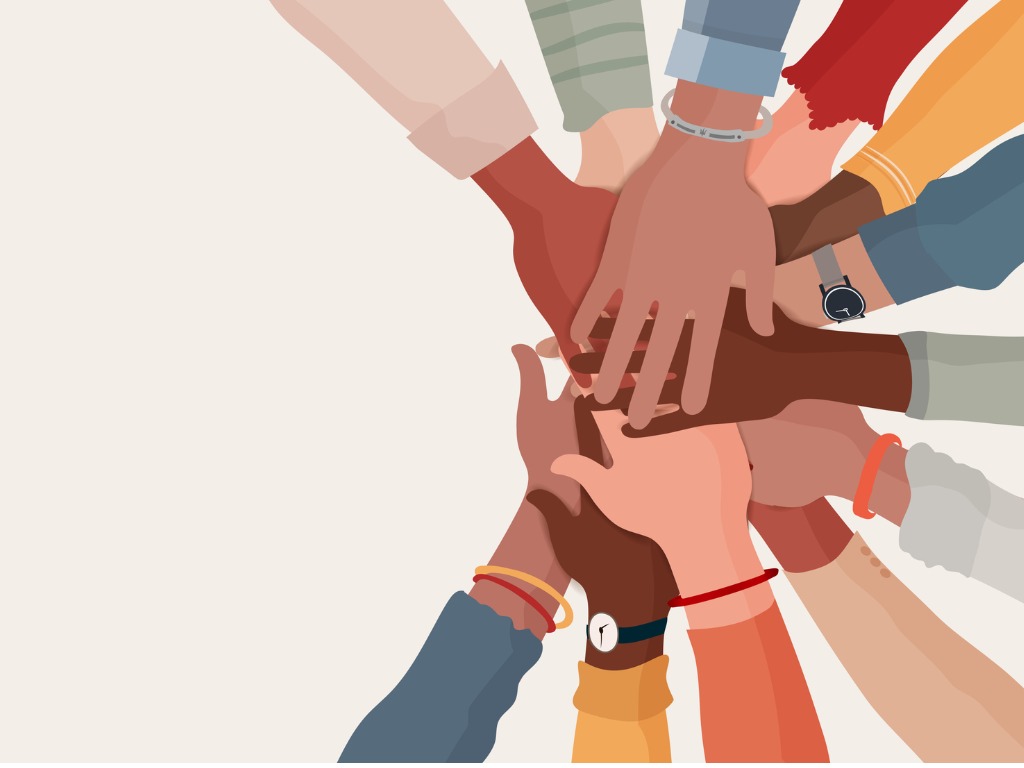
No Separation Between Humans
At the beginning of Lent I said we were going to look at Jesus as a Wisdom teacher and explore how he was a Life-Giver to the people who followed him and listened to him teach. I also said we were going back to the basics that Jesus taught. Basics that we’ve heard so many times that we almost don’t hear them anymore. But the way Jesus taught them and the way he lived them was radical in his day.
Today we’re talking about what Jesus called the second greatest commandment - to love your neighbor as yourself. We’ve all heard this. In fact, the Jews of Jesus’ time had heard it, too, because it comes from the 19th chapter of Leviticus, also known as the Holiness Code because of the line in it that encourages people “to be holy as God is holy.” And to be holy meant to separate oneself from everything that was unclean and impure. Hence, holiness essentially meant the same thing as purity. And being a sinner essentially meant one was impure.
In Jesus’ day people who kept kosher, who washed per the daily requirements, who were healthy and whole (not disfigured or chronically ill), who were Jewish, male and wealthy were primarily the ones who were considered holy. A woman’s menstrual cycle pretty much excluded her.
Because these things were so important to daily living, the command to love one’s neighbors seems to have taken less precedence. Or was easier to ignore.
We may not use the words “purity” or “cleanliness” to determine who is in and who is out today, but the same concept applies. We place value judgments on people to determine how “good” they are. If you are rich, male, white, American, white-collar, straight, and able you rate as more important or valuable. Body piercings, tattoos, driving a motorcycle, or wearing slippers at the store also lower your societal value.
You get the point, we have our biases, our non-official purity code of who is “better” and who isn’t.
Jesus’ teaching to “love your neighbor as yourself” may have been familiar, but it was his actions – eating with tax collectors and sinners, healing the ill and infirm, speaking with women and Gentiles - that truly shattered the purity codes of his time, that shattered the boundaries between people. And, frankly, they should shatter ours as well.
Cynthia Bourgeault, in her book Wisdom Jesus directs us to listen to this second commandment a little differently. She writes:
We hear “Love your neighbor as much as yourself.” (And of course, the next logical question then becomes, “But I have to love me first, don’t I, before I can love my neighbor?”) If you listen closely to Jesus’s teaching however, there is no “as much as” in there. It’s just “Love your neighbor as yourself” – as a continuation of your very own being. It’s a complete seeing that your neighbor is you.
This is metanoia once again, Jesus is trying to pull people out of their small mindsets of dualism and hierarchies and biases, to expand their vision beyond the mind and see that we are all one. There is no separation between humans. We are all one. And when the religious scholar affirmed that Jesus was correct, Jesus told him that he was getting close to the Kingdom of God. In other words, as we’ve discussed this Lent, his consciousness was expanding!
What might it look like to treat your neighbor as yourself, as an extension of yourself. Here are a couple of examples.
In August 2016, a couple named Cari and Lauri Ryding came home to find that the rainbow flag that had flown on their front porch had been stolen and their house egged. Anti-homosexual vandalism wasn’t at all what they expected in their close-knit Massachusetts neighborhood.
As it turned out, it also wasn’t what their neighbors expected. As Dennis Gaugh, one of the neighbors, explained to the Boston Globe, “We said, “Why don’t we all have the flags? They can’t take them from all of us.” Within days, the rainbow flag – the symbol of gay pride – was flying in solidarity with the Rydings on over 40 other homes in this family-friendly area. “One person’s act of fear and maliciousness created a powerful statement of love… Love wins!” said Lauri.
In 2018 an “informal network of Americans who came together spontaneously in the weeks after the Trump administration’s adoption of a “zero tolerance” immigration policy that led to children being separated from their parents at the border. These citizens raised money so that more than a dozen women could be released from detention. They offered their homes so these women would have a safe place to sleep each night on their journeys of thousands of miles to their children in New York. They contributed cars and their time to drive them one leg of the trip, from home to home to home. They shared clothing, food, and care. And because these good Samaritans loved their neighbors, these women were finally reunited in New York City with the children who had been stolen from them.
“Listen, this is our job,” Immigrant Families Together founder Meghan Finn told the New York Times. “This is our job because our government did something really heinous to these families, and [getting them home] isn’t just about putting them on a bus.”
Finally, Episcopal Bishop Michael Curry shares a story in his book, Love is the Way. Then night before co-officiating with the archbishop of Canterbury at the royal wedding of Prince Harry and Megan Markle, he and the archbishop were taking questions from a reporter. The reporter commented that it was widely known that the two disagreed on the subject of same-sex marriage and then asked how it was for them to be sitting there together for that interview and officiating at the royal wedding together. They both answered very similarly, essentially saying, “This is my brother, we follow Jesus. He teaches us the way of love; he didn’t teach us the way of agreement. That love dominates our relationship, not our agreements or disagreements.
How do we know when we’re on the right track to really loving our neighbor? What is the litmus test? What can help guide us? Agape (unbounded, unconditional love that sees all people as sacred) will show us the right thing to do. What would Love do? Where fear and selfishness exclude, love includes. Where fear and selfishness put down and bully, love lifts up. Where fear and selfishness hurt and harm, love heals and helps. Where fear and selfishness enslaves, love sets free.
In his “Letter from a Birmingham Jail,” Dr. King said it this way: “We are caught in an inescapable network of mutuality, tied in a single garment of destine. Whatever affects one directly, affects all indirectly.”
Lenten blessings,
Kaye