
Join us for service at:
Meadowbrook Country Club
2149 N. Green Bay Road
Racine, WI 53405
Sunday Summer Services 10 a.m.



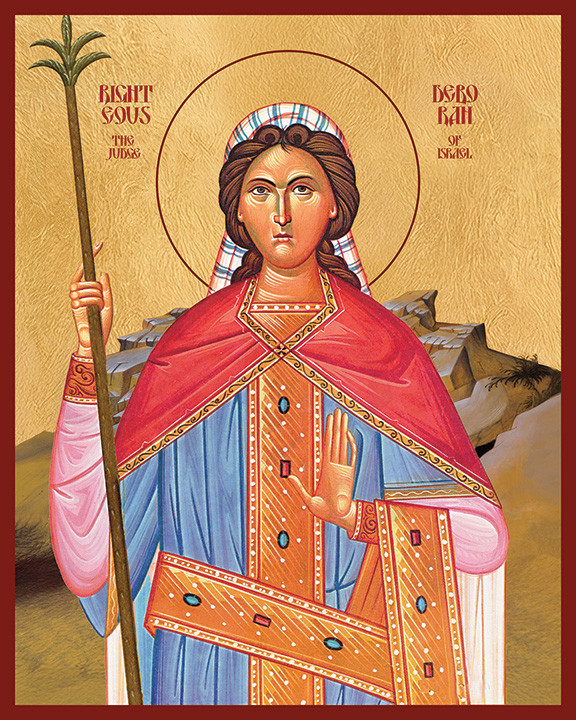
Deborah: A Song to Make Us Think
The book of Judges tells stories from a turbulent season in Israel’s early life, when the tribes were struggling for unity, safety, and freedom. These stories are not simple history lessons; they are ancient memories filled with poetry, myth, violence, courage, and theological meaning.
Among them is the story of Deborah, a prophet, governor, and leader whose courage still speaks. Deborah hears the call of God and summons Barak to help free the Israelites from Canaanite oppression. Barak will not go without her, a sign of her authority and the trust she inspires.
The battle is dramatic: a vulnerable people with inadequate weapons face the powerful Canaanite army of Sisera and his nine hundred iron chariots. The outcome relies on two women. Deborah leads with wisdom and faith. Jael, a simple tent-dweller, brings down Sisera with a tent peg and mallet.
This struggle between the powerful and the peasant class, or ordinary people, has happened countless times in history. One of the most recent is between Ukraine and Russia. It seems to me that we haven’t heard a whole lot about Ukraine these days. When I went out looking, I discovered that last month Ukraine had the highest number of civilian casualties since April 2022. Russian attacks killed at least 377 civilians and injured 2,129
How many Ukrainian Deborahs, Baraks and Jaels risked, and perhaps lost, their lives defending their homeland and fighting the ruthless war machine that is Russia? It is heartbreaking.
Judges 5, often called the Song of Deborah, is one of the oldest poems in the Bible, dating to about 1100 BCE, celebrates the unlikely victory of Israel against the Canaanites. Imagine for a moment how this song was joyfully taken up in Israel and sung through the ages, remembering how Yahweh was on the side of the vulnerable, gave courage to seemingly helpless women, and brought victory to the underdog. We can imagine how something similar could be sung in Ukraine, changing the name Sisera to that of a Russian general, or president. The vulnerable community, against all odds, and because of their bravery, and the intent of the Holy One, would exult in their victory.
While the Song of Deborah celebrates a military victory, it then does something unexpected. It calls us to take another look at the conflict and the people. In a unique and impactful twist, Deborah’s victory song for Israel ends with a glimpse into the home of Sisera’s mother. We see her fretting, wondering, worrying about her son, Sisera, who shouldn’t have been gone for so long. The unspoken question (to which we already know the answer) is whether he is dead or not. Her attendant tries to comfort her suggesting that he must be off celebrating with women and plunder. His mother repeats this to herself as if to convince herself, but we seem to sense that she knows the truth. Her son is never coming home again.
Victory songs are expected, but the wise prophetess, the great Mother of Israel, Deborah, reminds us that there are two sides to every story. She shows us the enemy, Sisera, defeated and shamed. And then she shows us the enemy again from a mother’s point of view. War always has a cost, not only for the side we’re cheering for who mourn the loss of their bravely fallen loved ones; but mothers (and fathers) of the so-called “enemy” also deeply mourn the loss of their children. We cannot forget this, lest we lose what is most important to our humanity – our empathy and compassion.
Political leaders and journalists will not seek to show us behind the scenes of the enemy, lest we become soft about the war. So, perhaps this role of remembering and having empathy is uniquely entrusted to the church. Jesus did remind us to “Love your enemies and pray for those who persecute you (Matthew 5:44).”
The church community must continue to remind us of our common humanity. Every person who dies in war had a mother, father and family. Every person is remembered as brave and heroic… even the ones who have cowered in fear. All sides love their children. That should be more important than the fight for oil or minerals or land. It is our common humanity, our common capacity for grief, our common cherishing of our children that is the ground for hope and peace.
I do not condone war or violence. Yet, I lift up Deborah because she not only helped save her vulnerable, oppressed people from a powerful enemy, she doesn’t let us get away with gloating. She wisely reminds us that there are families of the so-called enemy who are bereft and grieving. When will this stop?
Love & Light,
Kaye