
Join us for service at:
Meadowbrook Country Club
2149 N. Green Bay Road
Racine, WI 53405
Sunday Summer Services 10 a.m.



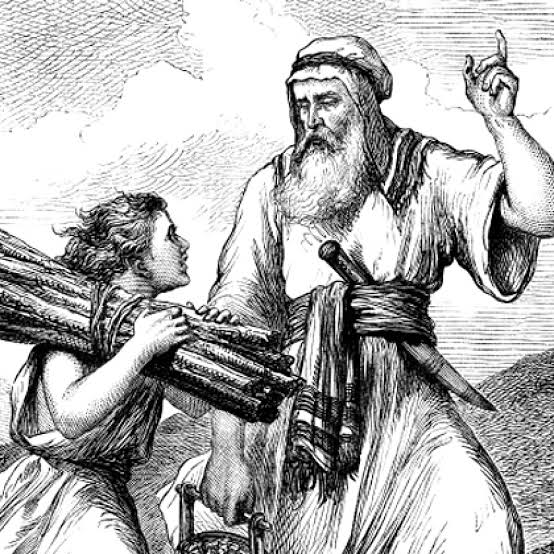
Abraham & Isaac: A Question of Faith
By the fifth week of our Old Testament series, Going In-Depth with the OT Stories, we arrived at one of the most difficult passages in Genesis: the story of Abraham being asked to sacrifice Isaac. It is a story that can stop us in our tracks. Child sacrifice is wrong. The idea of God asking for it as a test is deeply troubling. Abraham’s silence and obedience can feel equally unsettling. And, notably, Sarah’s voice is absent from the story altogether. Frankly, I don’t like this story one bit. But I decided to take a deep breath, a step back and delve deeper.
Genesis was never intended to be a history book. It is a collection of sacred traditions shaped over time by communities of faith, then woven together into a larger theological story. Israel was not isolated from the surrounding cultures of the ancient Near East, and those cultures influenced how people understood God, sacrifice, covenant, and faithfulness. Some scholars suggest this story may have served as a rejection of child sacrifice; others note that, however horrifying it is to us, the practice was known in the ancient world and would not have been an unfamiliar topic for Israel’s earliest audiences.
To hear this story more fully, we need to consider the community for whom Genesis was eventually gathered and shaped. One important audience was Israel in exile: a people who had lost their homeland, their city, their temple, and much of what had given them identity and security.
Imagine being among the Israelites taken into Babylonian exile after Jerusalem fell. Your home has been destroyed. The temple—the place you understood as the center of worship and divine presence—lies in ruins. Family members, neighbors, and friends have been killed, scattered, or left behind. Depending on when you were deported, exile could last 50 to 70 years. In the worldview of that time, whatever happened was understood as something God had either willed or allowed.
It is not hard to imagine the questions such a community might have carried: Why is this happening? Where is God? What did we do to cause this? Is our faith being tested? Are the promises of God still trustworthy?
From that perspective, the story of Abraham and Isaac may have sounded different to Israel in exile than it does to us. If they felt their faith was being tested, they may have recognized themselves in Abraham’s impossible moment.
The language of God “testing” people appears throughout the Old Testament. It was a common way ancient communities made sense of hardship, loss, and uncertainty.
Let me be clear: I do not believe God causes suffering in order to test our faith. Life itself can test faith. Grief, illness, injustice, fear, and uncertainty can bring us to the edge of what we thought we believed. Many of us have had moments when we questioned the presence or goodness of God. But I cannot believe in a God who inflicts pain simply to prove our loyalty.
For ancient Israel, however, suffering was often interpreted through the lens of divine testing or judgment. For a people grieving in exile, the story of Abraham may have offered a way to hold onto hope: Abraham faced the unthinkable, and yet God did not abandon the promise.
Still, the story remains difficult. Abraham had already demonstrated remarkable trust: he left his homeland, followed God into an unknown future, received the covenant, and believed the promise of descendants even in old age. Yet in this passage, he is asked to surrender the very child through whom that promise was to continue.
It is also fair to be disappointed in Abraham’s silence. Earlier in Genesis, Abraham boldly questioned God over the fate of Sodom and Gomorrah, pleading for the innocent. Here, when Isaac’s life is at stake, Abraham does not argue but blindly obeys.
Perhaps this story is not only about Abraham’s faithfulness, but also about God’s. Perhaps Israel in exile needed to hear that God’s promise had not disappeared, even when everything around them suggested otherwise. In the story, Abraham’s trust is seen, Isaac is spared, and the promise continues. For people who feared they might be completely destroyed, that would have mattered. The story could speak a word of reassurance: even in wilderness, even in terror, even when the future seems impossibly fragile, God’s promise is not finished.
Throughout Scripture, Abraham’s faithfulness is remembered when the people of God are facing hardship. Again and again, the theme returns: remain open to God, and trust that God remains faithful.
I find that I rarely use the word faith, even on Sunday mornings because faith is one of those religious words that often feels ambiguous and can carry a lot of baggage. For some it might feel manipulative, shallow, or controlling. For others, it raises questions: Does faith mean blind obedience? Faith in what kind of God? Is faith unreasonable because it cannot be proven? Can I ask questions and still be faithful?
For me, faith is not simply a belief handed to us by someone else. Faith grows from within—from our openness to life, love, grace, and the presence of Something More. What I believe about God changes and evolves as I live, experience, question, and reflect. But faith runs deeper. It is a kind of knowing in one’s soul.
There are seasons when faith feels strong, and seasons when it feels fragile. In those fragile seasons, we often depend on one another: on the presence of community, on shared commitment to goodness, on the light others carry when our own feels dim.
Because I struggle with this word, I challenged myself to spell out my faith. Allow me to share this with you, knowing that if you were to do the same exercise, it might sound very different.
- I have faith that an ineffable Divine Presence is with me at all times, even when I feel disconnected from that Presence.
- I have faith that an energy of Love permeates creation, and that we are connected by a spiritual web of Love and Light.
- My faith does not require or expect God to miraculously fix or save anything or anyone. I believe humans are responsible for our actions, and I understand our bodies to be mortal.
- I have faith that, whatever difficulty I am facing, there is Light to guide my way and Strength to help me through. As Brené Brown said, "I thought faith would say, 'I will take away the pain and the discomfort.' But what it ended up saying is 'I will sit with you in it.'"
- I have faith that intuition, synchronicity, and gentle nudges can be subtle ways the Divine moves in this world.
- I have faith that no matter how broken the world seems, there will always be people working for good.
- I have faith that this life is not the end of my spirit, soul, or essence, even though I cannot say for certain what comes next.
- I know my questions do not lessen my faith; in many ways, they deepen it.
- I know that when my faith wavers, or when I fall short, it does not lessen the Divine's love of me
I still don’t like this story. But I do hear a message within it: when people face hard and frightening things, God’s promise is not finished. Our questions do not disqualify us. Our struggles do not separate us from the Sacred Presence. No matter what wilderness we enter, may our faith hold—not as blind certainty, but as trust that Love is with us, guiding us, strengthening us, and refusing to let us go.
Love & Light!
Kaye